Department of Health Department of Health An Roinn Sláinte Männystrie O Pouste

Main navigation

  • Home
  • Topics
  • Publications
  • Consultations
  • Contact

Translation help

Translate this page

Select a language

  • Arabic — عربي
  • Chinese (Simplified) — 中文简体
  • Chinese (Traditional) — 中文繁體
  • Dutch — Nederlands
  • Filipino — Filipino
  • French — Français
  • German — Deutsch
  • Hungarian — Magyar
  • Irish — Gaeilge
  • Italian — Italiano
  • Latvian — Latviešu
  • Lithuanian — Lietuvių kalba
  • Polish — Polski
  • Portuguese — Português
  • Romanian — Română
  • Russian — Русский
  • Slovak — Slovenčina
  • Spanish — Español
  • Ukrainian — Українська
  • Neighbourhood Model of Health and Wellbeing
    Date published: 31 March 2026

    In the Health and Social Care Reset Plan, Minister Nesbitt made a commitment to developing a neighbourhood model of care, to deliver greater levels of care to our citizens in their local communities.

    In the Health and Social Care Reset Plan, the Health Minister made a commitment to developing a neighbourhood model of care, to deliver greater levels of care to our citizens in their local communities.  

    This model will see Community Pharmacy, GPs and their Federations, Voluntary and Community organisations, Trusts and independent providers working closely together, in formal partnerships, to provide integrated care. 

    The Neighbourhood Model is being developed and introduced in a phased approach:

    1. Design Phase September 2025 to January 2026: Agreeing the vision and underpinning principles for NI neighbourhood care and identifying best practices through a call for evidence.
    2. Build Phase January to April 2026: Publishing the policy guidelines and results of the call for evidence, establishing a neighbourhood development programme and systems for delivery.
    3. Implementation Phase from April 2026: Starting implementation, supporting establishment of the integrated neighbourhood teams and systems for measuring out comes, evaluating, investing, testing and scaling up good practice.

    Policy Framework

    The Framework outlines how a Neighbourhood Model will be developed across Northern Ireland.

    A Vision for Neighbourhood Health and Wellbeing in Northern Ireland – document below 

    Frequently Asked Questions

    These will be updated on this page

    What is a neighbourhood approach? 

    A neighbourhood approach brings local health, social care and community services together to support people earlier and closer to home. It focuses on prevention, joined‑up working and understanding the needs of local communities.

    How will the Neighbourhood Model operate in Northern Ireland?

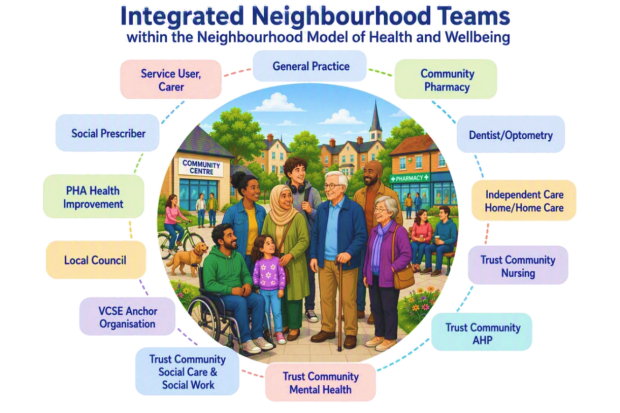
    Seventeen Integrated Neighbourhood Teams will serve communities across Northern Ireland, working within GP Federation areas. These teams will plan and deliver care together, building strong links with the smaller neighbourhoods they support.

    What is the driver for this change?

    Northern Ireland’s health and social care system faces rising demand, long waiting lists and pressure on all services including hospitals. Refocusing the system to resource the shifting of more care into communities will help people get support earlier, improve outcomes and reduce the need for avoidable ambulance and hospital use.

    When will it be implemented?

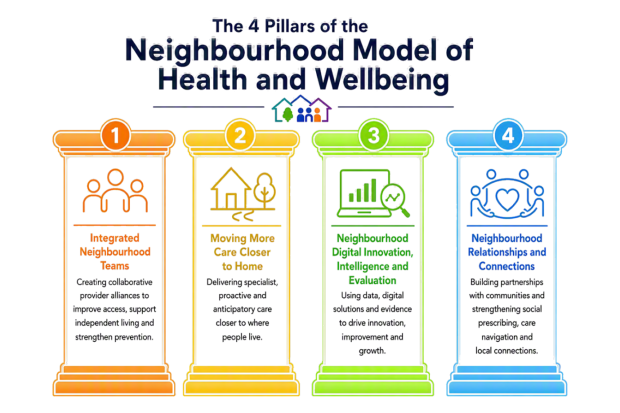
    Implementation begins in April 2026 and marks the start of long‑term change. All Integrated Neighbourhood Teams will begin forming in the first year, with progress made across all four pillars of the model.

    Where will the Integrated Neighbourhood Teams (INTs) be located?

    The 17 INTs will be established across Northern Ireland, aligned with current GP Federation footprints. 

    What are the potential benefits of the Neighbourhood Model for the public?

    People will receive care earlier and closer to their home, with services working more smoothly together. This approach aims to improve health outcomes, reduce the need for unnecessary hospital visits and ambulance conveyances and strengthen community support.

    How will the Neighbourhood Model be funded?

    A mixed funding approach will support the model, using existing resources, invest‑to‑save opportunities and external funding partnerships. This ensures long‑term change can get started, grow steadily and sustainably.

    How will the Neighbourhood Model link with AIPBs?

    AIPBs will adapt their role to strengthen local planning and integrated working alongside the new neighbourhood teams. Their expertise will support community planning and ensure strong alignment across the system between health and social care and other public services that offer support for the wider determinants of health, including housing.

    Why is the focus initially on older people?

    Older people often have the greatest need for health and social care and can face the biggest challenges in accessing timely support. By focusing on them first the Neighbourhood Model aims to deliver earlier, proactive care that helps people stay well at home for longer and avoid unnecessary hospital visits and stays.

    What is the difference between the Integrated Neighbourhood Teams (INTs) and previous models like the Integrated Care Partnerships (ICPs)?

    INTs will bring providers together to consider how they can work together on the day-to-day delivery of services for their community with shared priorities and local decision making rather than acting as an advisory or planning forum like ICPs. INTs will also have membership, representative of local services, and will have a strong focus on offering more care closer to home for the communities they serve by working together as part of long-term system change.

    How will the new Neighbourhood Model support the implementation of other strategic reforms in health and social care?

    The Neighbourhood Model for Health and Wellbeing is designed to complement and strengthen wider system reforms by creating local teams that can put these strategies into practice in a coordinated and community-focused way. By bringing providers together at neighbourhood level, INTs will help ensure that changes in adult social care, mental health, community pharmacy, nursing and general practice are better connected, easier to access and delivered closer to home. 

    Engagement

    Engagement with stakeholders has been a central tenet throughout the development of the Neighbourhood Model of Health and Wellbeing.  From the very beginning the Department has tested concepts with a wide range of internal and external stakeholders, and the input, challenge and support received has been critical in helping to shape the model as set out in this document.

    We are committed to engaging and communicating with stakeholders throughout the programme. If you would like to join our mailing list to receive updates, please click here.

    Call for Evidence

    The ‘Northern Ireland Neighbourhood Model of Care’ Call for Evidence was published on 8 October 2025 and ran until 25 November 2025.

    The purpose of this call was to seek examples of neighbourhood health initiatives from across Northern Ireland, to gather evidence about the partnerships they involve, the impact achieved and capture lessons learned to inform future policy, planning and practice. 

    Compendium of Good Practice

    The additional information shared by respondents to the Call for Evidence has been compiled into a Compendium of Good Practice. Compendium of Good Practice | Department of Health

    Documents

    • A Vision for Neighbourhood Health and Wellbeing in Northern IrelandAdobe PDF (1.55 MB)
    • NI Neighbourhood Model of Care - Call for Evidence - Summary ReportAdobe PDF (958.85 KB)
    • Blog from Professor Cathy Harrison introducing the Neighbourhood ProgrammeMicrosoft Word (16.38 KB)
    • Stakeholder NewsletterMicrosoft Word (67.46 KB)

    Help viewing documents

    Share this page Share on Facebook (external link opens in a new window / tab) Share on X (external link opens in a new window / tab) Share by email (external link opens in a new window / tab)

    Department footer links

    • Crown copyright
    • Terms and Conditions
    • Privacy
    • Cookies
    • Accessibility
    • The Northern Ireland Executive
    • The Executive Office
    • Department of Agriculture, Environment and Rural Affairs
    • Department for Communities
    • Department for Education
    • Department for the Economy
    • Department of Finance
    • Department for Infrastructure
    • Department for Health
    • Department of Justice
    • nidirect.gov.uk — the official government website for Northern Ireland citizens