Northern Ireland Guidance - Selling tobacco, herbal smoking products and cigarette papers
Changes to age of sale rules and related regulations for tobacco and herbal smoking products and cigarette papers from 29 October 2026 and 1 January 2027.
Summary
From 1 January 2027, it will be an offence to sell tobacco products, herbal smoking products and cigarette papers to anyone born on or after 1 January 2009.
It will also be an offence for anyone aged 18 or over to buy, or attempt to buy, tobacco products, herbal smoking products or cigarette papers on behalf of a person born on or after 1 January 2009.
It is currently a legal requirement for retailers to display a notice that is visible at points of sale to inform customers about the age of sale for tobacco products. This requirement will remain in place. From 1 January 2027, this notice must be updated to include information about the new age of sale.
This guidance explains:
- the age of sale restrictions for tobacco products, herbal smoking products and cigarette papers from 1 January 2027
- age of sale notice requirements for tobacco retailers from 1 January 2027
- restrictions on the free distribution of these products from 29 October 2026
- restrictions on selling these products at substantial discounts from 29 October 2026
This guidance is mainly intended for retailers, who will need to understand the changes in the law. It may also be useful for:
- wholesalers
- business owners
- enforcement authorities
- people who use these products
Products in scope
The products in scope of the restrictions are:
- tobacco products
- herbal smoking products
- cigarette papers
For tobacco products, this includes but is not limited to:
- cigarettes
- hand rolling tobacco
- cigars
- cigarillos
- pipe tobacco
- waterpipe tobacco, such as shisha
- nasal tobacco, commonly known as snuff
- chewing tobacco
- heated tobacco
- tobacco blunts
For herbal smoking products, this includes but is not limited to:
- herbal blunts
- herbal cigarettes
- herbal shisha
Snus and other relevant oral tobacco products (as defined for Northern Ireland in section 77 of the Tobacco and Vapes Act 2026) have been banned in the UK since 1992. The new age of sale does not apply to these products.
Age of sale
From 1 January 2027, it will be an offence for retailers, including online retailers, to sell tobacco products, herbal smoking products or cigarette papers to anyone born on or after 1 January 2009.
Before making a sale, retailers must be satisfied that the customer was born before 1 January 2009.
Selling to someone under the age of sale is a criminal offence and may result in formal action, including the issuing of an fixed penalty notice (FPN) or prosecution.
Customers attempting to buy tobacco products, herbal smoking products or cigarette papers should expect to show ID if they are asked to prove they are above the age of sale.
For further information on age of sale, see article 3 of The Health and Personal Social Services (Northern Ireland) Order 1978 https://www.legislation.gov.uk/nisi/1978/1907/contents
The current restrictions on displays of tobacco products and prices will remain in place. Retailers can currently only accept a request to see a product or price list from someone aged 18 or over. This will change so that retailers can only accept a request from someone born before 1 January 2009.
Age verification
If a retailer is unsure whether a customer attempting to buy tobacco products, herbal smoking products or cigarette papers was born before 1 January 2009, they should verify the customer’s age.
The new age of sale is based on a fixed date, so retailers will only need to establish whether the customer’s date of birth is before 1 January 2009.
This is different from other age-restricted products, where retailers need to calculate the customer’s age from their date of birth.
The tobacco and Vapes Act 2026 will provide a defence to retailers if they took all reasonable steps to avoid the commission of an offence.
Regulations will also be debated in the Northern Ireland Assembly to specify steps that retailers can take to verify a customer’s age.
By taking these steps, retailers may have a defence if they are accused of committing an age of sale offence. This means that if a retailer can prove to a court that they have taken these steps, the court should not convict them. We will update this guidance with further information on age verification.
Enforcement of age of sale
Penalties for selling to underage customers
From 1 January 2027, it will be an offence for a person to sell tobacco products, herbal smoking products or cigarette papers to someone born on or after 1 January 2009.
From 1 January 2027, if a person commits an offence of selling tobacco products, herbal smoking products or cigarette papers to an underage person, they can receive a £250 FPN for committing this offence.
Alternatively, a person who commits this offence may receive a larger fine on summary conviction. A summary conviction is a finding or plea of guilt for a crime in a magistrates’ court.
Any fine that is issued can be up to level 5 on the standard scale (currently £5,000). For more information about standard scales, see The Fines and Penalties (Northern Ireland) Order 1984: https://www.legislation.gov.uk/nisi/1984/703/contents
It will be for the relevant local council to determine the most appropriate enforcement action, including whether to issue an FPN or pursue prosecution.
For further information on age of sale, see article 3 of the Health and Personal Social Services (Northern Ireland) Order 1978: https://www.legislation.gov.uk/nisi/1978/1907/article/3
Reporting underage sales
If you suspect that someone is selling tobacco products, herbal smoking products or cigarette papers to underage people, contact your local Council in Northern Ireland: https://www.nidirect.gov.uk/contacts/local-councils-in-northern-ireland
Age of sale notices
Notice requirements
Retailers are responsible for displaying an age of sale notice in a prominent place, which is visible at each point of sale of tobacco products.
From 1 January 2027, the requirements for tobacco age of sale notices will change to align with the amended age of sale. From this date, retailers who sell tobacco products will have to display a notice reading:
“It is illegal to sell tobacco products to anyone born on or after 1 January 2009”
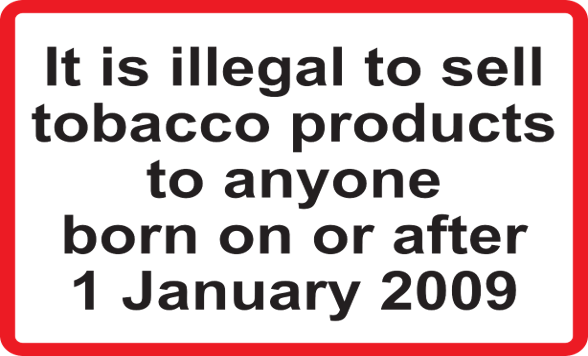
Age of Sale notice
Figure 1: example notice
Figure 1 is a rectangular sign with a red border and black text.
For further information on age of sale notices, see article 4D of the Health and Personal Social Services (Northern Ireland) Order 1978:
https://www.legislation.gov.uk/nisi/1978/1907/article/4D
Size requirements for notices
Retailers are responsible for making sure that notices are printed at the appropriate size. Retailers can produce and display a notice different to the example provided in this guidance, as long as the minimum size requirements are met.
Subject to Regulations being made, the notices will be required to be a minimum size of 297 millimetres (mm) by 420mm (A3 size), with each character no smaller than 21mm in height.
Subject to Regulations being made, the same wording and size requirements noted above will also apply to the age of sale notices that bulk tobacconists must display at the entrance to their tobacco areas to qualify for display exemptions. Further details on bulk tobacconists and existing exemptions can be found in - The Tobacco Advertising and Promotion (Display) Regulations (Northern Ireland) 2012 www.legislation.gov.uk/nisr/2012/246/contents/made
Printable signs will be available to download from the DOH website in due course
Retailers will only need to display the age of sale notices from 1 January 2027.
Enforcement of age of sale notices
From 1 January 2027, retailers who fail to display the required age of sale notice outlined in the sections above may receive-
- a £100 FPN for committing this offence, or;
- a larger fine on summary conviction up to level 3 on the standard scale (currently £1,000)
Until 1 January 2027 retailers selling tobacco related products will still be required to display the current age of sale notice.
For further information on FPNs, see the Northern Ireland guidance ‘https://www.health-ni.gov.uk/articles/northern-ireland-guidance-tobacco-vaping-and-nicotine-products-fixed-penalty-notices’.
Proxy purchasing
From 1 January 2027, it will be an offence for anyone aged 18 or over to buy, or attempt to buy, tobacco products, herbal smoking products or cigarette papers on behalf of someone who was born on or after 1 January 2009. This is known as proxy purchasing.
All retail staff should be alert to the risk of proxy purchasing and take steps to prevent it. Staff should be trained to identify situations where a customer may be attempting to buy these products for someone who is underage.
If staff suspect proxy purchasing, they should refuse the sale. For further information on proxy purchasing, see article 4A of the Health and Personal Social Services (Northern Ireland) Order 1978: https://www.legislation.gov.uk/nisi/1978/1907/article/4A
Enforcement of proxy purchasing
A person who commits a proxy purchasing offence may be issued with a £250 FPN.
Alternatively, a person may receive a larger fine on summary conviction. This can be up to level 5 on the standard scale (currently £5,000).
For proxy purchases, it is the person who buys (or attempts to buy) the product on behalf of someone under the age of sale that commits the offence.
For further information on FPNs, see the Northern Ireland guidance ‘https://www.health-ni.gov.uk/articles/northern-ireland-guidance-tobacco-vaping-and-nicotine-products-fixed-penalty-notices’.
Free distribution
It is already an offence to give away any tobacco product, or coupon, to a member of the public. This offence applies if the purpose is or effect will be to promote a tobacco product.
A coupon is defined as anything that can be redeemed for a product, service, cash or any other benefit. This includes both physical and electronic forms. It can be redeemed either by itself or along with something else, such as an emailed code.
From 29 October 2026, the ban on free distribution will also apply to herbal smoking products and cigarette papers.
The ban on free distribution also applies to products that have the purpose or effect of promoting a tobacco product, herbal smoking product or cigarette papers, without being one of these products. For example, a lighter with tobacco product branding.
Businesses must not offer free samples or promotional product giveaways to members of the public. This applies whether in-store, online or through third-party promotions.
Example scenarios that would constitute an offence include:
- giving away cigarette papers as a free gift
- giving free samples to customers to try
For information on how this applies to vaping and nicotine products, see the Northern Ireland guidance ‘https://www.health-ni.gov.uk/articles/northern-ireland-guidance-selling-vaping-and-nicotine-products’.
Substantial discounts
From 29 October 2026, it will be an offence to sell tobacco products, herbal smoking products, cigarette papers or coupons for these products at a substantial discount. This offence applies if the purpose is or effect will be to promote any of these products.
A substantial discount is a price reduction that significantly lowers the cost of a product compared with its standard selling price. Whether a discount is substantial can vary depending on the product and the type of promotion.
Selling products, or coupons, at a substantial discount is being banned to stop businesses trying to find a way round the free distribution offence.
Selling tobacco products, herbal smoking products or cigarette papers to customers in-store or through online promotions at a nominal sum, such as 10p, would likely be an offence.
The substantial discount offence also applies to products that have the purpose or effect of promoting a tobacco product, herbal smoking product or cigarette papers, without being one of these products. For example, a lighter with tobacco product branding.
These restrictions do not affect normal discounting practices. Retailers can continue to sell unsold stock at a reduced price as part of normal business. Bulk and trade discounts may still apply.
Businesses must follow existing advertising and promotion rules when discounting products. These are outlined in the Tobacco Advertising and Promotion Act 2002 and its subsequent regulations, until these are replaced by the Tobacco and Vapes Act 2026.
For information on how this applies to vaping and nicotine products, see the Northern Ireland guidance ‘https://www.health-ni.gov.uk/articles/northern-ireland-guidance-selling-vaping-and-nicotine-products’.
For further information on free distribution and substantial discounts, see Article 4L of the Health and Personal Social Services (Northern Ireland) Order 1978: (from 29 October 2026).
Enforcement of free distribution and substantial discounts
A person who commits an offence of freely distributing a product or selling a product at a substantial discount can receive a £250 FPN for committing this offence.
For further information on FPNs, see the Northern Ireland guidance ‘https://www.health-ni.gov.uk/articles/northern-ireland-guidance-selling-vaping-and-nicotine-products’.
Alternatively, a person can receive a summary conviction or conviction on indictment. A conviction on indictment means that a person has been found guilty, or has pleaded guilty, in the Crown Court.
On summary conviction, the maximum punishment is 6 months in prison, a fine not exceeding the statutory limit, or both. A person found guilty on conviction on indictment can be sentenced to imprisonment for up to 2 years and they may also receive an unlimited fine or face both penalties.
Enforcement for persistent offenders
Retailers may be subject to a restricted premises order or restricted sales order if they commit 3 relevant offences within a 5-year period. These orders last for a period specified in the order, which must not be less than 28 days or more than 3 years.
Payment of an FPN does not prevent that offence counting towards the persistent offending provisions of the Tobacco Retailers Act (Northern Ireland) 2014
https://www.legislation.gov.uk/nia/2014/4/contents
Where the statutory threshold for persistent offending has been met, a council may apply for a Restricted Premises Order (RPO) or Restricted Sales Order (RSO) irrespective of whether any relevant FPNs have been paid.
Who can sell tobacco products, herbal smoking products and cigarette papers
There are no additional restrictions on the age a person must be to sell tobacco products, herbal smoking products or cigarette papers beyond the restrictions for child employment generally.
For more information, see Child employment: minimum age children can work: https://www.nidirect.gov.uk/articles/employment-rights-young-people.
For information on how this applies to vaping and nicotine products, see the Northern Ireland guidance ‘https://www.health-ni.gov.uk/articles/northern-ireland-guidance-selling-vaping-and-nicotine-products’.
Non-retail sales
The new age of sale restriction applies to retail sales only. It does not apply to business-to-business sales (wholesale) or sales to an organisation.
For example, someone born on or after 1 January 2009 can:
- work in a retail business and buy tobacco products, herbal smoking products and cigarette paper stock from a wholesaler
- work for a research organisation and buy tobacco products, herbal smoking products and cigarette papers for scientific purposes.
However, a retailer cannot sell to someone underage for their personal use.
Duty free
Duty free sales are subject to UK age of sale restrictions.
If tobacco products, herbal smoking products or cigarette papers are bought outside the UK, the local age of sale applies.
For guidance on bringing tobacco products into Northern Ireland and the UK from abroad, see:
- Bringing goods into the UK for personal use: arriving in Northern Ireland (https://www.gov.uk/bringing-goods-into-uk-personal-use/arriving-in-northern-ireland )
- Bringing goods into the UK for personal use: travelling between Great Britain and Northern Ireland (https://www.gov.uk/bringing-goods-into-uk-personal-use/travelling-between-great-britain-and-northern-ireland)